/shibari-tatami
AI Japanese Rope Portraits
Make it with your museAI Japanese Rope Portraits
Open this world on the wall, and make it with your muse.
all 9 frames of her, in this world ↓
The Red Rope Tatami Register
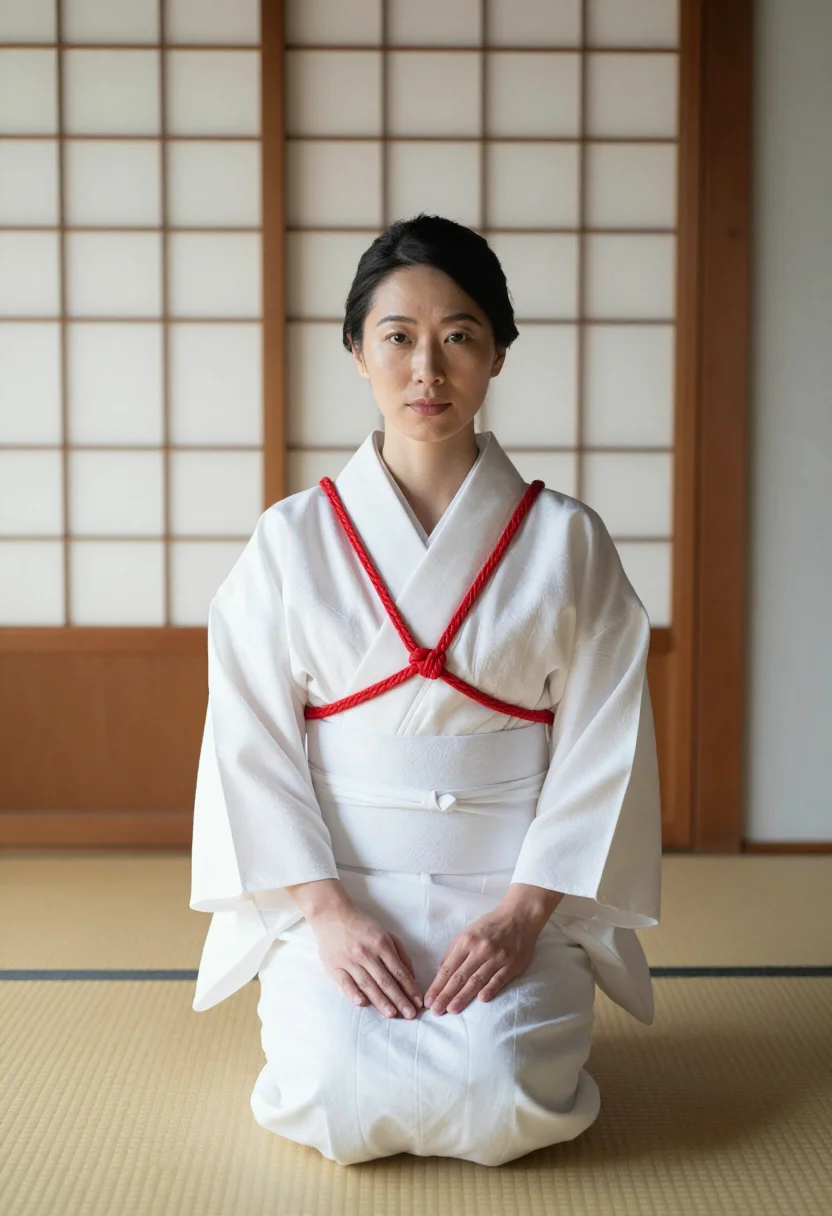
Red jute rope on tatami: a white cotton yukata, the knots and lines of the rope as the silhouette, a grid of soft shoji light. It is the shibari portrait search made specific: one place, one palette, one muse, held across nine frames.
The arc moves in three clear stages, never mid-change: kneeling upright in a white cotton yukata with a red jute rope harness over it, shoji light in a soft grid behind her; then kneeling side to the lens, the rope lines crossing the yukata at chest and waist; then lying on her side on the tatami in the yukata, the rope lines crossing under the shoji shadow. Palette stays fixed throughout — yukata white, tatami straw, one red in the rope — so the nine frames read as one session, not nine unrelated shots.
Every frame is photographic in construction — light, fabric drape, real skin texture — never drawn, never animated. A Japanese woman in her thirties, black hair in a low knot, a calm composed expression, held as the same face through all nine frames. What stays through all three looks: the rope. Each frame is written as a brief before it is rendered and composed from the first pixel forward.
Frequently asked questions
- What is in the AI Japanese Rope Portraits pack?
- Nine frames. A tatami room, soft light through shoji paper: kneeling upright in a white cotton yukata with a red jute rope harness over it, shoji light in a soft grid behind her; then kneeling side to the lens, the rope lines crossing the yukata at chest and waist; then lying on her side on the tatami in the yukata, the rope lines crossing her waist and hips under the shoji shadow.
- Are these real photographs or AI-generated?
- AI-generated, built on photographic principles: light, fabric drape and skin texture, never drawn and never animated. The rope stays through all three looks.
- Is this a real photo altered, or something else? What about age?
- Nothing is altered from an existing image. Each frame is written first — the setting, the wardrobe, the light, the pose — then composed from the first pixel forward. The muse is a composed adult, not a real person's photograph; if you cast your own face by selfie, that is your choice and your face. Access requires confirming you are 18 or over.
- What does the look do across the nine frames?
- It moves in three clear steps, never mid-change: the yukata and rope upright on the tatami, the yukata worn loose at the shoulders with the rope over it, then the yukata and rope on her side on the tatami. The yukata stays on in every frame.
- What is the wardrobe and setting?
- A tatami room, soft light through shoji paper. Palette: yukata white, tatami straw, one red in the rope. The rope stays through all three looks.
- Is this an instruction for tying rope?
- No. The rope is the picture's graphic line, the way a ribbon or a chain would be: a harness already tied, seen as knots and lines over cloth. Nothing here teaches a technique.
- Do I need to upload a selfie?
- It is optional. One clear front-facing photo casts the muse in your likeness across all nine frames; skip it and the house casts its own. The selfie steers the face — it is never the image being changed.
- I searched something close to japanese portrait — is this the same pack?
- Close enough to matter. This pack answers japanese portrait, AI shibari, rope art portrait and art portrait — shibari portrait is the spine, and every close variant of that search lands on this same nine-frame set.
- How is this different from the other packs in the same vein?
- The other silk-kimono packs are silk; this one is cotton, tatami and a single red rope.
- How is this different from a chat or prompt-box AI tool?
- A chat you steer, or a prompt box refined one frame at a time, gives you one image at a time. This is a pre-engineered nine-frame series — one world, one arc — delivered whole for one payment.
- Can I use the frames once unlocked?
- Personal and creative use. Not for commercial redistribution, not to present as a real person's photograph, and not for use against any individual.
- How is this different from a generic AI portrait generator?
- A generic generator gives you one image at a time with no continuity. This is a whole session in one world, one arc — nine frames built to hold together as a set rather than as scattered, unrelated outputs.
- Who is in the photos?
- A muse you choose. 32 AI faces, none of them a real person.
Who Reaches for the Red Rope Tatami Register
- People whose search was shibari portrait or rope art portrait and want the rope as a composed art portrait rather than a snapshot
- Photographers studying how a single red line reads against white cotton and straw
- Anyone building a moodboard around Japanese portrait and AI shibari that has to hold one grade across nine images
- Writers and worldbuilders who need one consistent character in a tatami room, soft light through shoji paper
- Collage artists who need photographic-quality material with coherent, consistent lighting
- Adults curious about the Red Rope Tatami register of AI photography at an accessible entry price
About Ovid
Ovid is a house of pictures that were never taken. Most AI image tools ship one giant catalog of poses and aesthetics; the output looks like every other generated image on the internet. Ovid goes the other way. Each pack is a single editorial brief — light, styling, scene composed in the grammar of the great fashion editorials — hand-curated against real references and tested before it ships. Free preview before you pay. Packs are one-time. No template generator, no feed. A fashion house, not a catalog.