/reversed-chair
AI Chair Pose Portraits
Make it with your museAI Chair Pose Portraits
Open this world on the wall, and make it with your muse.
all 9 frames of her, in this world ↓
The Chair Pose Register
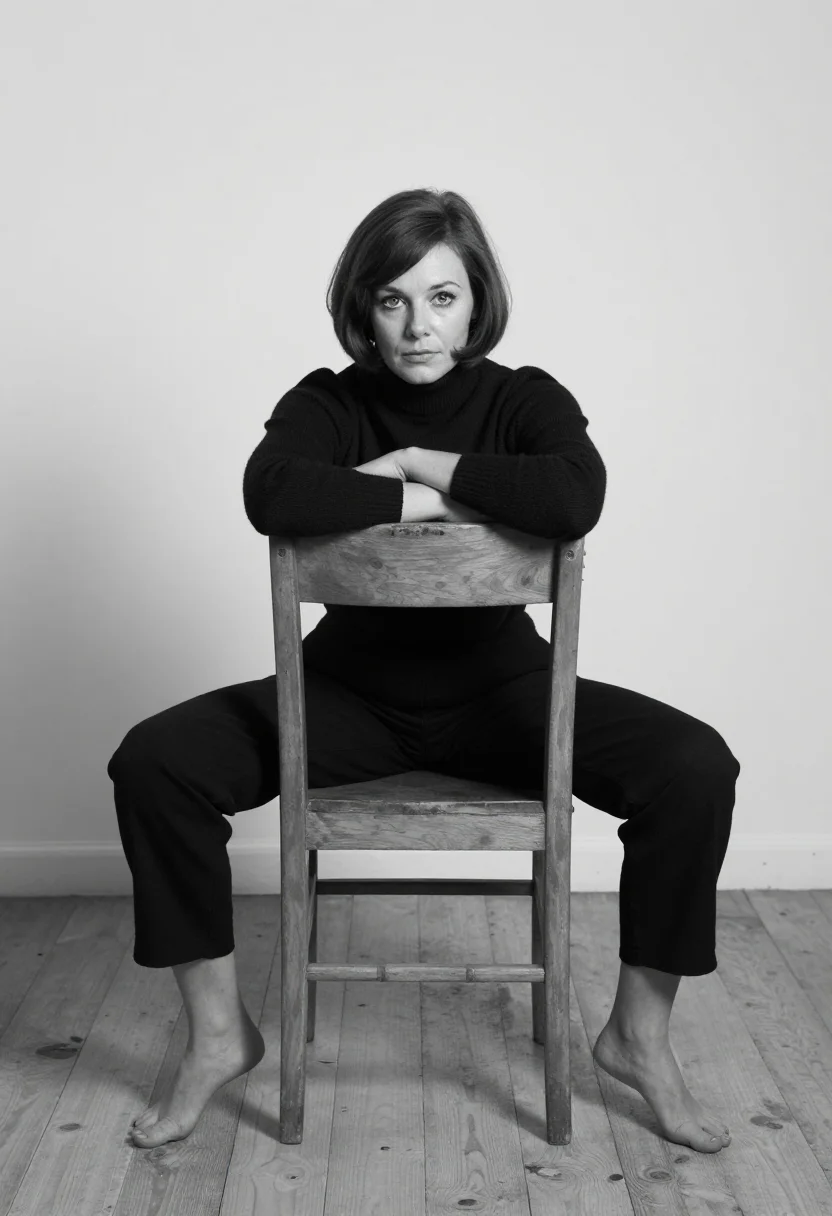
Chair Pose is a one-pose register: the chair turns backward, the arms never unfold. The world is a bare white studio under one hard side light, and the palette holds at black wool, plywood, white cyc, hard side light, monochrome from the first frame to the last, so the nine read as one session rather than nine unrelated shots.
The arc moves in three clear stages, never mid-change: fully dressed astride the reversed chair, arms folded, chin on wrists; then the turtleneck's sleeves pushed up, the same fold of the arms; then a long black wool coat open over the turtleneck, the arms folded exactly as before. Nothing is caught halfway; each stage is a state the camera can rest in.
Every frame is photographic in construction — light, fabric drape, real skin texture — never drawn, never animated. The folded-arm pose stays through all three stages, including the last. Each image is written before it is rendered and composed from the first pixel forward, which is what lets chair pose photoshoot hold one grade across the whole set.
Frequently asked questions
- What is in the AI Chair Pose Portraits pack?
- Nine frames in a bare white studio, 1963, a plywood chair turned backwards: a black turtleneck and trousers, sitting astride the chair with arms folded on its back and chin on wrists, one hard side light; then the turtleneck's sleeves pushed up, the same fold of the arms; then a long black wool coat open over the turtleneck, the same fold of the arms; black and white throughout.
- Are these real photographs or AI-generated?
- AI-generated, built on photographic principles. The folded-arm pose on the chair's back stays through all three stages, including the last. Every frame reads as a photograph, not as an illustration.
- Is this a real photo altered, or something else? What about age?
- Nothing is altered from an existing image. Each frame is written first — the setting, the wardrobe, the light, the pose — then composed from the first pixel forward; the muse is not a real person, and no real person is named or depicted. Access requires confirming you are 18 or over, and the final third is the most relaxed look in the set, the coat open and the arms still folded.
- How does the wardrobe move across the nine frames?
- It moves in three clear steps, never mid-change: fully dressed astride the chair, the turtleneck's sleeves pushed up, then the long black wool coat open over it. Nothing is caught halfway.
- What's the wardrobe and setting?
- A black turtleneck and black trousers, bare feet, then a long black wool coat. The world: a bare white studio, 1963, a plywood chair turned backwards, one hard light from the side. Palette: black wool, plywood, white cyc, hard side light, monochrome.
- Do I need to upload a selfie?
- It's optional. One clear front-facing photo casts the muse in your likeness across all nine frames; skip it and the house casts its own. The selfie steers the face — it is never the image being changed.
- I searched something close to straddling chair portrait — is this the same pack?
- Close enough to matter. This pack directly answers reversed chair pose, black and white chair portrait, arms folded on chair back — chair pose photoshoot is the spine, and every close variant of that search lands on this same nine-frame set.
- Why does the pose never change across nine frames?
- Because one chair, one pose, three states is the whole idea — the backrest and the folded arms are the constant, and only the wardrobe carries the arc from the turtleneck to the coat.
- How is this set built?
- It is a pre-engineered nine-frame series — one world, one arc — delivered whole for one payment.
- Can I use the frames once unlocked?
- Personal and creative use. Not for commercial redistribution, not to present as a real person's photograph, and not for use against any individual.
- How is this different from a generic AI portrait generator?
- A generic generator gives you one image at a time with no continuity. This is a whole session in one world — the chair turns backward, the arms never unfold — nine frames built to hold together as a set rather than as scattered, unrelated outputs.
- Who is in the photos?
- A muse you choose. 32 AI faces, none of them a real person.
Who Reaches for the Chair Pose Register
- People whose search was straddling chair portrait and who want the full nine-frame arc rather than a single static image
- Photographers studying how a monochrome palette of black wool, plywood, hard side light carries one set across three stages
- Costume and wardrobe people looking at how a black turtleneck and a long black wool coat read across the arc
- Writers and worldbuilders who need one consistent character across a bare white studio
- Anyone building a moodboard around the chair pose register that has to hold one grade across nine images
- Collage artists who need photographic-quality material with coherent, consistent lighting
- Adults curious about the chair pose register of AI photography at an accessible entry price
About Ovid
Ovid is a house of pictures that were never taken. Most AI image tools ship one giant catalog of poses and aesthetics; the output looks like every other generated image on the internet. Ovid goes the other way. Each pack is a single editorial brief — light, styling, scene composed in the grammar of the great fashion editorials — hand-curated against real references and tested before it ships. Free preview before you pay. Packs are one-time. No template generator, no feed. A fashion house, not a catalog.