/persian-garden
AI Persian Garden Portraits

Make it with your museAI Persian Garden Portraits
Open this world on the wall, and make it with your muse.
all 9 frames of her, in this world ↓
The Persian Garden Register: Flat Light, Carpet Reds, a Walled Paradise
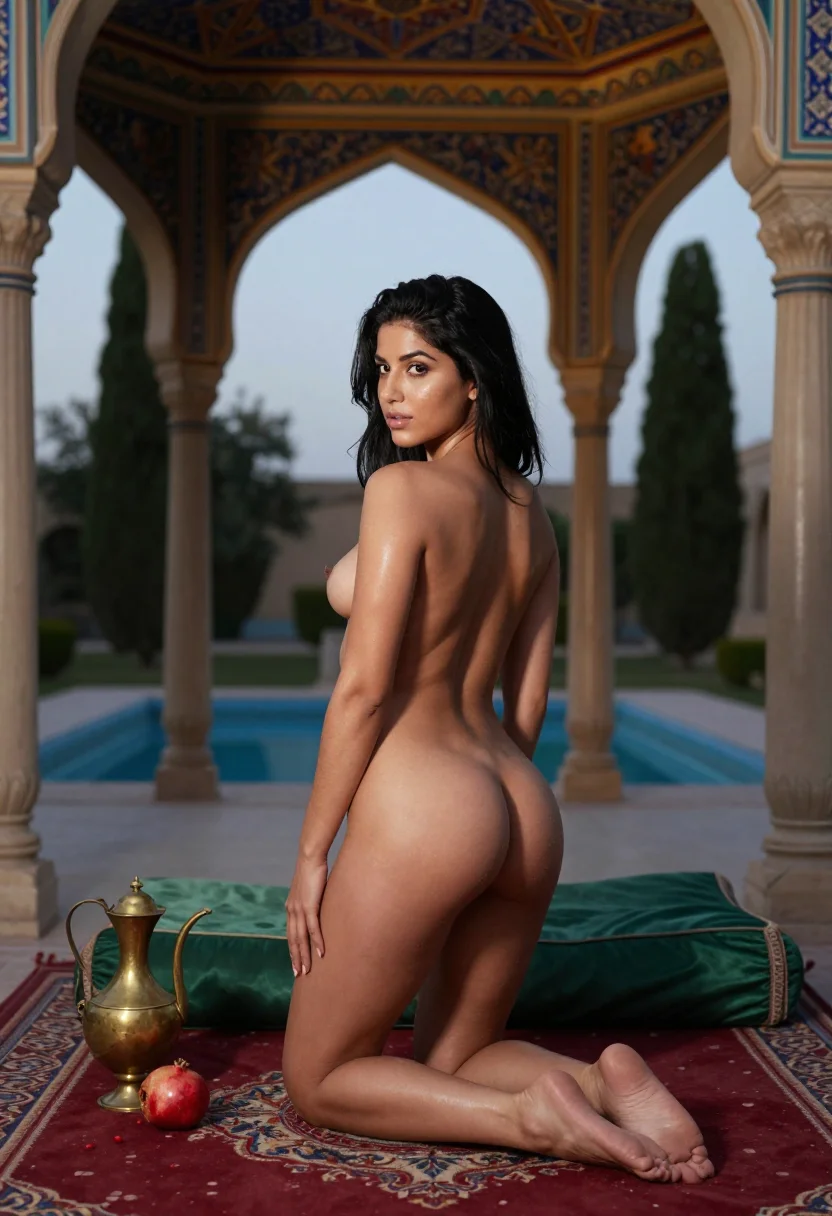
The chahar bagh is the oldest closed garden there is — four quarters, a channel of water, cypress for permanence and rose for the season, all of it walled against the plain outside. The pavilion sits where the water crosses. Everything in this pack happens there: the carpet spread over the pavilion floor, the bowl of pomegranates set beside her hand, the wine ewer standing on the pile where she put it down, the pool's blue rectangle one step below the platform. She is not visiting the garden. She is what the garden was built around.
The light is the pack's whole argument. Persian miniature painting works without cast shadow — the page is lit evenly across its full surface, and space is built by stacking planes rather than by modelling with shade. Carried into photographic rendering, that means skin described at even strength across the figure, the carpet's madder reds and indigo blues at full saturation behind her, the pomegranate's split flesh as bright as the water. No dramatic falloff, no rim light, no studio grammar at all: just complete, unhurried description.
The objects are staged, never handled for effect. The ewer stands on the carpet and her hand rests at its neck; the bowl sits beside her hip rather than being lifted toward the lens; the nightingale's cage stays blurred at the frame's edge where a miniature would have placed it as an incident of the garden rather than a subject. Her hands find the carpet's pile, the bowl's rim, the cushion's silk. The recline on the cushions is framed from the head end at three-quarters, so the composition reads as a painted panel rather than as a pose offered to a camera.
The wardrobe is stated, never narrated. The long silk robe is belted over a fine shift in all nine frames; on the carpet it falls in folds, by the pool it drapes over the cushion, and on the pavilion's cushions it lies under her hip with the carpet's pile at the edge of the frame. All nine frames are photographic in construction and AI-generated in execution — the muse is composed from a written brief, and no real person was photographed to produce any of them.
Frequently asked questions
- What is in the AI Persian Garden Portraits pack?
- Nine frames inside a shah's garden pavilion, the same silk robe throughout. Three seated on the carpet with a bowl of pomegranates set beside her, three reclining by the pool's blue rectangle with the wine ewer standing on the carpet, three on the pavilion's cushions under the painted ceiling with cypress and rose beds beyond the arch. One payment for the set.
- Are these real photographs or AI-generated?
- AI-generated, built on photographic principles inside a painted convention. The Persian miniature works without cast shadow — light arrives flat, even and clear across the whole picture plane — so the carpet's reds, the pool's blue, the pomegranate's split flesh and the silk all read at full saturation at once. Rendered as photography rather than illustration, but lit like the page it descends from.
- Is this an AI tool that alters a real photo of me?
- No. Nothing is read from an existing image, because no existing image is read. Each frame is written first — the pavilion, the robe, the flat light — and composed from the first pixel forward. There is no photograph underneath any of it.
- Why does the garden make this work?
- Because the Persian paradise garden is walled. The chahar bagh is a rectangle of water, cypress and rose held inside a boundary that keeps the desert out and everything else in, and the pavilion sits at its centre as the one place the whole garden was built to serve. Nothing outside is looking. The silk robe is the garment of the whole garden, worn from the carpet to the cushions.
- What are the three settings?
- Pavilion Carpet — the painted columns, the carpet's deep reds under her, a bowl of split pomegranates set beside her hand and a wine ewer standing on the pile. Pool's Edge — the water's blue rectangle at her feet, the ewer at her hand, cypress dark beyond, a nightingale's cage blurred at the frame's edge. Pavilion Cushions — the painted ceiling above, the bolster under one arm, roses and pool held in the same flat light through the arch.
- What does she wear across the set?
- A long silk robe over a fine shift, belted at the waist in all nine frames. On the carpet the robe falls in soft folds around her; by the pool it drapes over the cushion beside her; on the pavilion's cushions it lies under her hip, the carpet's pile beyond it. The wardrobe stays the same throughout.
- Why is the light so flat?
- It is the miniature's own light, kept deliberately. Persian painting refuses modelling shadow: figures, carpets, water and fruit are all lit equally, and depth comes from the stacking of planes rather than from shade. That gives skin a clarity studio lighting cannot — no falloff, no dramatic edge, just even description all the way across the figure.
- Do I need to upload a selfie?
- It is optional. One clear front-facing photo casts the muse in your likeness across all nine frames; skip it and the house casts its own. Your selfie steers the face — it is never the image being altered.
- What does the set look like from first frame to last?
- One garden, three positions, one light: seated on the carpet with the ewer and pomegranates, reclining by the pool, then on the pavilion's cushions under the painted ceiling. Delivered whole for one payment, nine frames held as one set.
- Can I use the frames once unlocked?
- Personal and creative use. Not for commercial redistribution, not to present as a real person's photograph, and not for use against any individual.
- Is there an age requirement?
- Access requires confirming you are 18 or over. The muse is a composed synthetic adult woman, written and AI-generated rather than photographed, so she is not a real person; if you choose to cast your own likeness from a selfie, that likeness is yours and yours alone.
- Who is in the photos?
- A muse you choose. 32 AI faces, none of them a real person.
Who Reaches for the Persian Garden Register
- People whose search was a persian garden portrait and who want the walled pavilion rather than a generic studio set
- Painters and illustrators studying how flat shadowless light describes a figure differently from modelled studio light
- Worldbuilders and writers needing one consistent muse across a single enclosed garden sequence
- Photographers curious about a lighting logic with no falloff and no rim — the miniature's even wash carried into photographic rendering
- Textile and costume people looking at how silk robe and carpet pile answer the same flat light
- Collage artists assembling a persian art portrait moodboard that has to hold one grade across nine images
- Adults who want the paradise-garden register of AI photography at an accessible entry price
About Ovid
Ovid is a house of pictures that were never taken. Most AI image tools ship one giant catalog of poses and aesthetics; the output looks like every other generated image on the internet. Ovid goes the other way. Each pack is a single editorial brief — light, styling, scene composed in the grammar of the great fashion editorials — hand-curated against real references and tested before it ships. Free preview before you pay. Packs are one-time. No template generator, no feed. A fashion house, not a catalog.