/peking-opera-dresser
AI Peking Opera Dresser Portraits

Make it with your museAI Peking Opera Dresser Portraits
Open this world on the wall, and make it with your muse.
all 9 frames of her, in this world ↓
The Peking Opera Register: Crimson, Kingfisher Blue and a Painted Half-Face
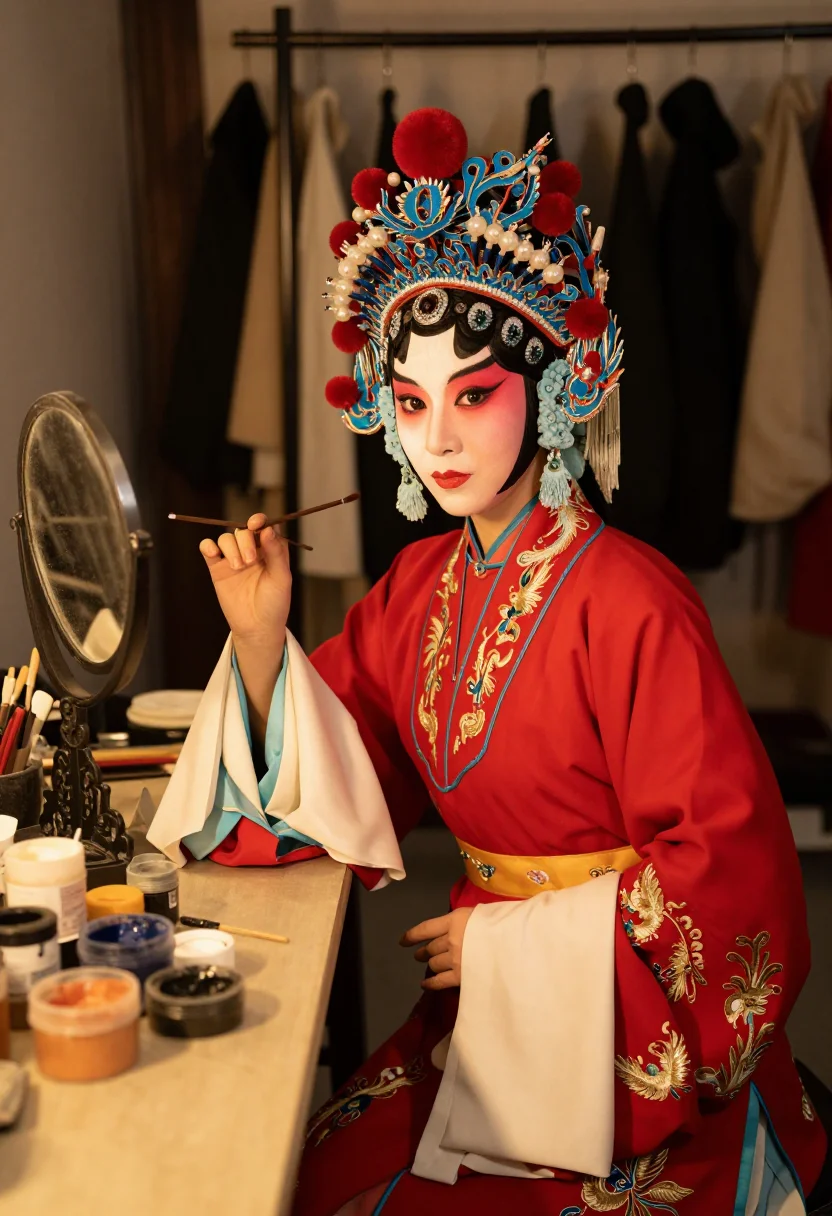
This pack is a dressing room and its wings, told in nine frames. A table crowded with paint pots and brushes, a round mirror, racks of embroidered costumes, a painted scenery flat of mountains and clouds, a red stage curtain. The Chinese opera portrait that results rests on what theatre already does: a woman half in character and half herself, face half painted, is the picture.
Light is warm throughout. Tungsten at the table is close and golden on the paint and the gold embroidery; in the wings the stage's own light spills from one side and leaves the rest of the space dark. The palette is crimson, kingfisher blue, rose and white face paint, and gold, held fixed so the three looks read as one backstage hour. The crown's beads supply the highlights, trembling in the last look.
Each look moves one step and never lands halfway: the full robe and crown with her eyes on the mirror; the robe worn open with the water sleeves trailing; then the robe worn closed with the phoenix crown in the wings. The crown and the half-painted face survive the arc. The muse is unambiguously an adult woman throughout, and the company on the curtain is fictional.
All nine frames are photographic in construction and AI-generated in execution — warm tungsten and spilled stage light, specular on beads, gold thread and lacquer, greasepaint, silk and skin rendered from photographic principles rather than drawn. Nothing in the set documents a real person or a real place; the register is borrowed as a staging tradition.
Frequently asked questions
- What is in the AI Peking Opera Dresser Portraits pack?
- Nine frames backstage at a Peking opera company. Early: at a dressing table crowded with paint pots and brushes, a full crimson opera robe embroidered in gold with long white water sleeves, the phoenix crown of kingfisher-blue beads and red pompoms on her head, the face half painted rose and white, meeting her own eyes in a round mirror. Middle: the robe worn open with the water sleeves trailing to the floor, the crown kept, seated sideways on a lacquered stool with racks of embroidered costumes behind her. Last: the robe worn closed and the crown on, standing in the wings beside a painted scenery flat of mountains and clouds with the red stage curtain gathered at her shoulder and the half-painted face turned toward the stage.
- Are these real photographs or AI-generated?
- AI-generated, built on photographic principles. Warm tungsten dressing-room light at the start, close and golden; in the wings the stage's warm light spills across her from one side while the wings stay dark behind. The crown's beads and the gold embroidery supply the points of light. It reads as a photograph made in that place, not as an illustration of one.
- How does the look move across the nine frames?
- It moves in three steps and never lands halfway: the full crimson robe and crown at the dressing table; then the robe worn open with the water sleeves trailing, the crown kept; then the robe worn closed with the phoenix crown, in the wings. Three frames per look, each a settled state.
- What is she wearing, and where is she?
- A full crimson opera robe embroidered in gold with long white water sleeves and a phoenix crown of kingfisher-blue beads and red pompoms, in a backstage dressing room crowded with paint pots, then in the wings beside a painted scenery flat. The palette is crimson, kingfisher blue, opera rose and white, and gold, in warm dressing-room glow. The crown and the half-painted face travel through all nine frames; the company is fictional. The muse is a Chinese woman from Beijing, black hair under the crown.
- How is this different from the house's other Chinese packs?
- All of them draw on Chinese tradition, in different registers. Peking Opera Dresser is theatre: crimson robe, painted face, backstage. The other packs are the modern hanfu revival under red lanterns with a painted brow flower, and the restraint of a pale-green beizi in grey daylight. The chinese opera portrait searches land here, in the dressing room.
- I searched chinese opera portrait — is this the same pack?
- Close enough to matter. This pack answers chinese opera portrait, peking opera portrait and chinese portrait directly — a crimson embroidered opera robe, a kingfisher-blue phoenix crown and a half-painted face, backstage. Searches for AI chinese girl, phoenix crown, water sleeves, half-painted face and backstage end on this same nine-frame set too.
- Do I need to upload a selfie?
- It is optional. One clear front-facing photo casts the muse in your likeness across all nine frames; skip it and the house casts its own. Your selfie steers the face only — it is never the image being worked on.
- How is this different from a chat or prompt-box AI tool?
- A chat you steer, or a prompt box you refine one image at a time, gives you one image at a time. This is a pre-engineered nine-frame series — one world, one arc, one backstage hour — delivered whole. Better if you want a coherent set, worse if you want to negotiate every frame.
- Can I use the frames once I have them?
- Personal and creative use. Not for commercial redistribution, not to present as a real person's photograph, and not for use against any individual.
- Is there an age requirement?
- Access requires confirming you are 18 or over. The muse is an adult woman composed from a written brief rather than photographed — a synthetic archetype, not a real person and not a depiction of any living individual. If you cast your own face into the set, that likeness is yours by your own choice and yours alone.
- Who is in the photos?
- A muse you choose. 32 AI faces, none of them a real person.
Who Reaches for the Peking Opera Register
- People whose search was chinese opera portrait or peking opera portrait and who want the backstage, not the performance
- Anyone searching art portrait who wants theatre, paint and costume rather than a plain studio
- Photographers studying warm tungsten against stage spill on a half-painted face
- Costume people looking at an embroidered robe, water sleeves and a beaded crown, worn open and worn closed
- Writers and worldbuilders who need one consistent performer from the table to the wings
- Moodboard makers building a crimson, kingfisher-blue and gold palette that has to hold across nine images
- Adults curious about the Chinese portrait register of AI photography in a theatre
About Ovid
Ovid is a house of pictures that were never taken. Most AI image tools ship one giant catalog of poses and aesthetics; the output looks like every other generated image on the internet. Ovid goes the other way. Each pack is a single editorial brief — light, styling, scene composed in the grammar of the great fashion editorials — hand-curated against real references and tested before it ships. Free preview before you pay. Packs are one-time. No template generator, no feed. A fashion house, not a catalog.