/parachute-silk
AI Parachute Silk Portraits
Make it with your museAI Parachute Silk Portraits
Open this world on the wall, and make it with your muse.
all 9 frames of her, in this world ↓
The Postwar Register: The Evening Cloth Stopped Being War Material
In 1945 women across Europe cut up surplus parachutes and sewed them into wedding dresses, slips and nightgowns, because rationing left no other silk in the world. This pack is one such evening. The tenderness in it is specific: the same yardage that fell out of the sky over somewhere terrible is being pinned to a kitchen table and made into a trousseau by hand.
The material carries the history in plain sight. A canopy's panel geometry survives the cutting, so the finished nightgown wears its rigging lines as seams — luxury with its provenance still legible. The light is one weak kitchen bulb and the wireless's glow, warm and falling off fast, and every frame is photographic in construction: real silk slip, real pins, real skin under a forties tungsten.
The parachute silk search ends here, honestly: nothing in these nine frames was pulled off a real photograph of a real person. Each is written before it is rendered — the kitchen, the canopy, the pins, the pose — and composed from the first pixel forward. No real person was photographed to produce any of them.
Frequently asked questions
- What is in the AI Parachute Silk Portraits pack?
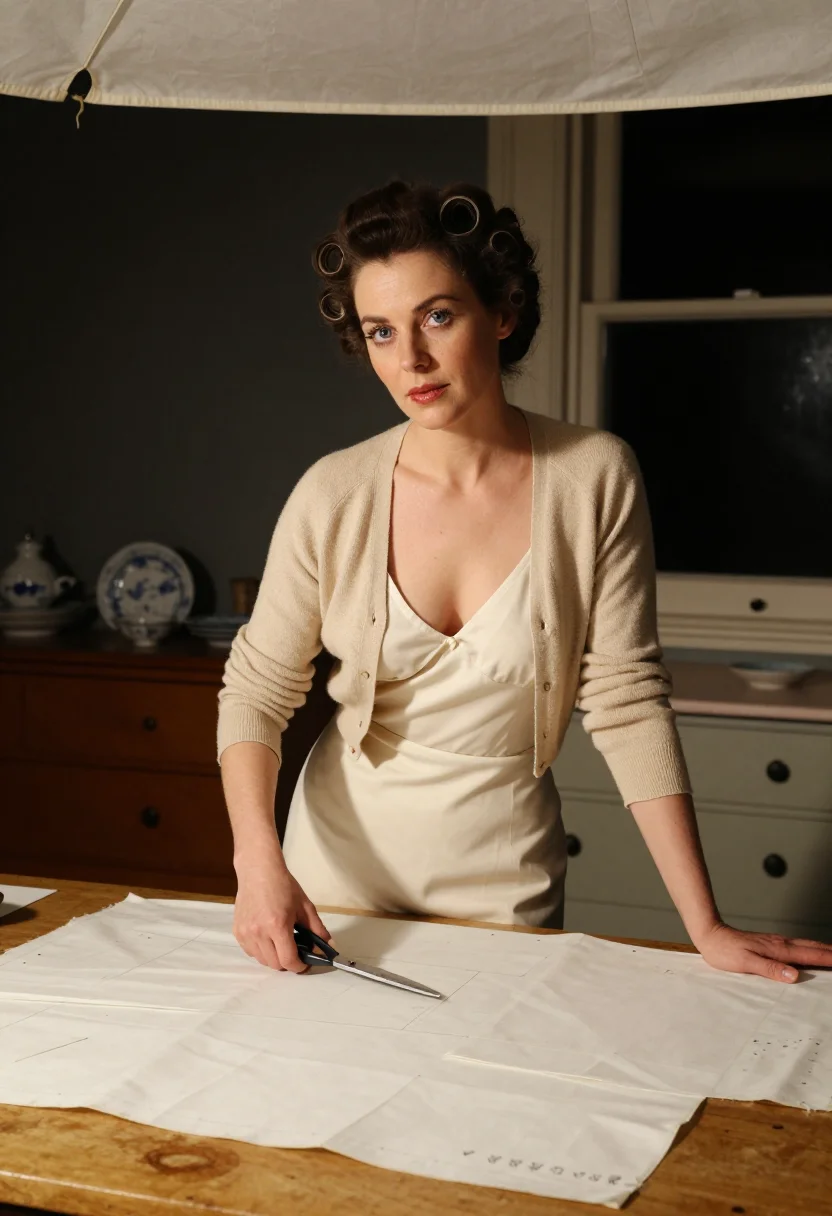
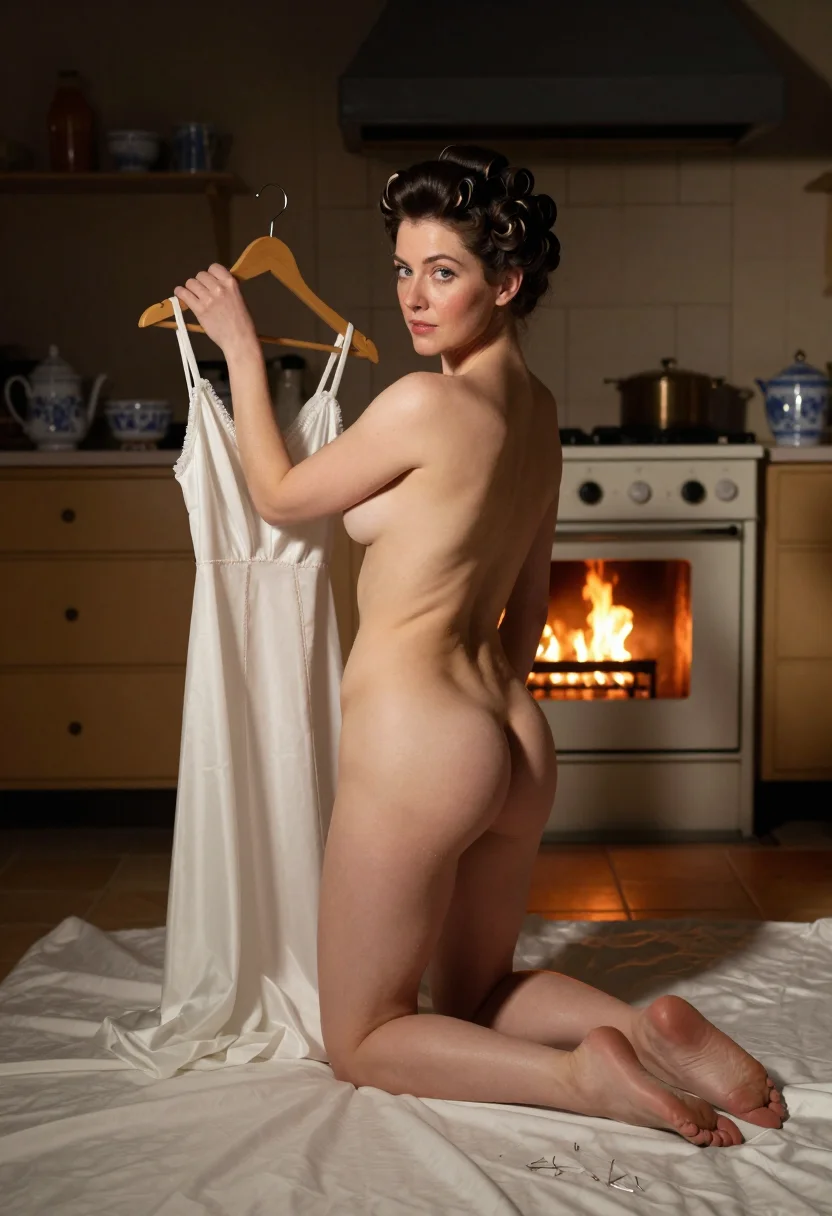
- Nine frames across one 1945 evening: three at the kitchen table in a slip and cardigan with the shears poised over the spread white canopy and pattern pieces pinned to the silk's panels; three with the cardigan off, draped in the uncut silk wound toga-wise for the first fit, seams pinned at her shoulder in wartime radio light; three bare but for the finished nightgown held up against her front on its hanger, the parachute's rigging lines still visible as seams.
- Are these real photographs or AI-generated?
- AI-generated, built on photographic principles. Parachute silk is thin, cool and slippery, and its panel geometry is visible in every fold; forties kitchen tungsten is warm, weak and comes from one bulb, so the whole room falls off into shadow at the edges.
- Is this a real photo altered, or something else? What about age and compliance?
- Nothing is altered from an existing image. Each frame is written first — the kitchen, the silk, the light, the pose — then composed from the first pixel forward; the muse is not a real person. Access requires confirming you are 18 or over, and the pack contains adult content in its final third.
- What does the look change across the nine frames?
- It moves in three clear steps, never mid-change: slip and cardigan at the table, then the cardigan off and the uncut silk wound toga-wise for a fitting, then bare with the finished nightgown held in hand on its hanger. Nothing is caught halfway.
- What's the wardrobe and setting?
- A cotton slip, a knitted cardigan, yards of white parachute silk and the nightgown it becomes — against a kitchen table, dressmaker's pins, shears and a wireless set in a 1945 kitchen.
- Do I need to upload a selfie?
- It's optional. One clear front-facing photo casts the muse in your likeness across all nine frames; skip it and the house casts its own. The selfie steers the face — it is never the image being changed.
- Is this a Candy AI or Promptchan alternative?
- Adjacent territory, different product. Candy AI is a chat you steer; Promptchan is a prompt box refined one frame at a time. This is a pre-engineered nine-frame series — one kitchen, one evening, one length of silk — delivered whole for one payment.
- Can I use the frames once unlocked?
- Personal and creative use. Not for commercial redistribution, not to present as a real person's photograph, and not for use against any individual.
- How is this different from a generic AI portrait generator?
- A generic generator gives you one image at a time with no continuity. This is one evening's work in one kitchen, told in order — nine frames built to hold together as a set.
- Who is in the photos?
- A muse you choose. 32 AI faces, none of them a real person.
Who Reaches for the Postwar Register
- People whose search was a wartime silk portrait and who want the historical tenderness rather than a period costume shoot
- Photographers studying how one weak tungsten bulb behaves across thin silk, wool knit and bare skin
- Costume and sewing people looking at how a parachute canopy is actually cut down into a garment
- Writers and worldbuilders who need one consistent character across a single 1945 interior
- Anyone building a postwar moodboard that has to hold one grade across nine images
- Collage artists who need photographic-quality period material rather than studio glamour
- Adults curious about the historical register of AI photography at an accessible entry price
About Ovid
Ovid is a house of pictures that were never taken. Most AI image tools ship one giant catalog of poses and aesthetics; the output looks like every other generated image on the internet. Ovid goes the other way. Each pack is a single editorial brief — light, styling, scene composed in the grammar of the great fashion editorials — hand-curated against real references and tested before it ships. Free preview before you pay. Packs are one-time. No template generator, no feed. A fashion house, not a catalog.