/maharani
AI Maharani Portraits
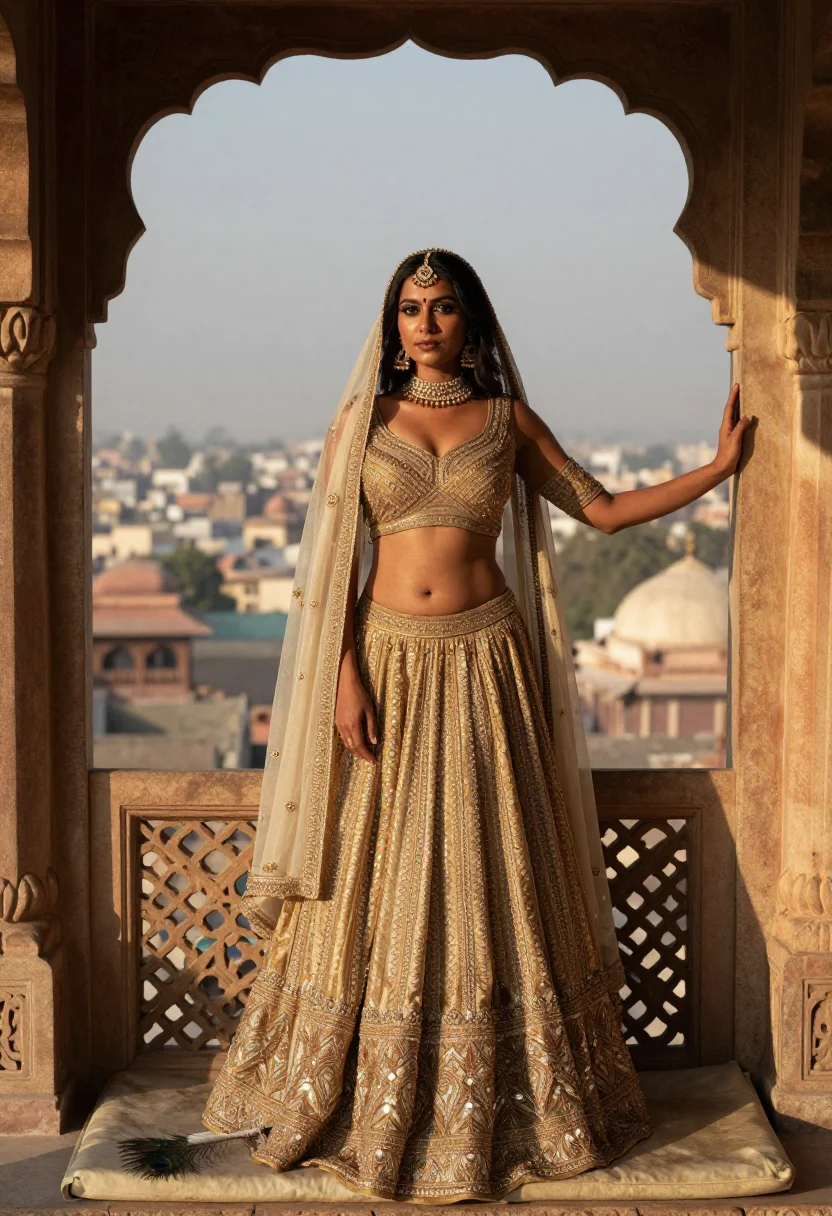

Make it with your museAI Maharani Portraits
Open this world on the wall, and make it with your muse.
all 9 frames of her, in this world ↓
The Maharani Register: Sandstone, Gold Thread and a Thousand Lamps
The maharani portrait is a room before it is a woman. A palace zenana is built to be looked out of and never into: the jharokha gives her the whole city and gives the city nothing back, and behind it the sheesh mahal has no window on the world at all. This pack runs from one to the other — a carved stone screen over roofs and domes in afternoon haze, a cushioned seat with a peacock-feather fan set down on it, then a mirrored chamber where a few oil lamps become a thousand points and the walls hand back fragments of whoever is in the room. The jewels stay on in every frame. They are the register's spine.
Three lighting conditions carry the nine frames. The jharokha is the hardest and the highest: open afternoon sky broken into small shapes by carved sandstone, laying a lattice across the dupatta's silk and the gold at her brow, with the city below going flat in haze. The middle third moves inward and down — lamps at low level, mirrors beginning to answer, gold thread on the lehenga's skirt catching more of it than the velvet does. The last third is the pack's signature: an omnidirectional warm light with no single origin, hundreds of small speculars firing from the walls and ceiling at once, so shadows hardly form and the faceted stones at her throat carry most of the contrast in the frame.
The wardrobe moves one step per third and never lands between two states. Lehenga, choli and dupatta at the window, with one hand on the screen and the other holding the dupatta's edge; the dupatta over one shoulder, the lehenga and choli still on, seated low with a hand on the silk and the other on her thigh; then the same lehenga and choli in the mirrored chamber, reclined on the cushions with one arm along the bolster and the other hand at her hip, the jewels catching the lamps, framed from the head end at three-quarters. The fan stays set down and is never held; hands find screen, silk, thigh, bolster or hip, and no limb is pointed at the lens in any of the nine.
The palace boudoir here runs closer to fine art portraiture than to glamour: the room carries the frame, the figure is what the light is for. All nine frames are photographic in construction and AI-generated in execution — the specular behaviour of faceted gold, the small hard shapes a carved screen throws, mirrored glass multiplying a lamp, velvet and skin rendered from photographic principles rather than drawn or painted. The palace is borrowed for its light and its objects. The muse is a composed archetype; nothing in the set depicts a real woman or documents a real court.
Frequently asked questions
- What is in the AI Maharani Portraits pack?
- Nine frames inside a palace zenana, in three states. At the jharokha window: a heavy lehenga and choli with the dupatta over her head and shoulders, jewels at brow, ears and throat, one hand on the carved stone screen and the other holding the dupatta's edge, the city's roofs and domes below in afternoon haze, a peacock-feather fan set on the cushioned seat. In the sheesh mahal: the dupatta over one shoulder, the lehenga and choli still on, seated low with one hand on the silk and the other resting on her thigh, mirrors throwing the lamps back in a thousand points. In the mirrors: the maang tikka on her brow and the jewels at her throat, reclined on the cushions in the same lehenga and choli. Three frames per state, one payment for the set.
- Are these real photographs or AI-generated?
- AI-generated, built on photographic principles. The jharokha is a carved screen against open afternoon sky — a hard, high, hazy source broken into small shapes across sandstone and gold thread. The sheesh mahal is the opposite problem and the most distinctive light in the pack: mirrored walls and ceiling turn each oil lamp into hundreds of small specular points, so the light is warm, low, omnidirectional and never quite resolves into one direction. Velvet, gold, mirrored glass and skin each answer that differently. It reads as a photograph made inside a real palace room, not as a painting of one.
- Is this a depiction of a real maharani?
- No. The muse is a composed archetype — the idea of a queen's private chamber, assembled from a written brief — not a portrait of any real woman, living or historical, and not a claim about any particular court or dynasty. She is an adult woman who exists only in these nine frames.
- What is she wearing across the nine frames?
- A heavy lehenga and choli under a dupatta at the window, with jewels at brow, ears and throat. In the middle third the dupatta sits over one shoulder and the lehenga and choli stay on. In the last third the mirrored chamber shows the same lehenga and choli, with the maang tikka and the jewels at the throat. The wardrobe stays on across all nine frames; each frame is a settled state rather than a step in a sequence.
- What is a sheesh mahal, and why does the pack end there?
- A sheesh mahal is a mirrored chamber — walls and ceiling set with thousands of small mirror pieces so that a few lamps become a whole sky of light. It sits deep in the zenana, the women's quarter, and it has no window on the outside world: nobody can see in, and there is nothing to see out. That is why the last third belongs to it. The room is the setting, and the mirrors multiply the figure into fragments while they are at it.
- How is this different from the Mughal Zenana pack?
- Different court, different material, different century's taste. The Mughal zenana is white marble, jali screens throwing diamonds of light, fine muslin and a bath under pietra dura inlay — cool, pale and geometric. This one is Rajput in temperament: sandstone and heavy silk, a jharokha over a city, velvet cushions and a mirrored chamber lit by lamps. If you want marble and rose water, start there; if you want gold, mirrors and lamplight, start here.
- Why do the jewels stay on?
- Because they are the point of the register — this is a jewelled portrait set, the whole look built around the pieces. Jewellery is what a queen wears with her rank rather than as clothing, so the jewels and the lehenga are the constant through every frame, and the last third keeps the jewels in the foreground while the mirrors do the work. It is also the pack's best light problem, since faceted gold under lamplight is where the mirrored room does its most interesting work.
- Is the palace setting historically accurate?
- Period-shaped rather than museum-exact. The jharokha's carved screen, the peacock-feather fan, the maang tikka, the low velvet cushions and the mirrored chamber are drawn from Rajput palace architecture and its photography; the pack borrows that register for its light and its objects, and does not document a particular palace, court or person. Costume drama, not an archive plate.
- Do I need to upload a selfie?
- It is optional. One clear front-facing photo casts the muse in your likeness across all nine frames; skip it and the house casts its own. Your selfie steers the face only — it is never the image being worked on.
- What does the set look like from first frame to last?
- One palace, three states, three lighting conditions: the lehenga at the carved window in afternoon light, the cushions of the sheesh mahal with the skirt still on, and the mirrored chamber under the lamps. Delivered whole for one payment — one world and one arc across nine frames.
- Can I use the frames once unlocked?
- Personal and creative use. Not for commercial redistribution, not to present as a real person's photograph, and not for use against any individual.
- Is there an age requirement?
- Access requires confirming you are 18 or over. The muse is an adult woman composed from a written brief rather than photographed, so she is not a real person; if you cast your own face into the set, that likeness is yours and yours alone.
- Who is in the photos?
- A muse you choose. 32 AI faces, none of them a real person.
Who Reaches for the Maharani Register
- People whose search was a maharani portrait or an indian queen portrait and who want a palace rather than a studio backdrop
- Anyone building a royal indian boudoir set that has to hold one grade across nine images
- Photographers studying an omnidirectional mirrored source — hundreds of small speculars with no single light direction
- Costume and jewellery people looking at how gold thread, velvet and faceted stones behave against skin under lamplight
- Writers and worldbuilders who need one consistent character moving deeper into a private quarter
- Collage and moodboard makers who need photographic-quality palace material rather than stock heritage imagery
- Adults curious about the jewelled boudoir register of AI photography
About Ovid
Ovid is a house of pictures that were never taken. Most AI image tools ship one giant catalog of poses and aesthetics; the output looks like every other generated image on the internet. Ovid goes the other way. Each pack is a single editorial brief — light, styling, scene composed in the grammar of the great fashion editorials — hand-curated against real references and tested before it ships. Free preview before you pay. Packs are one-time. No template generator, no feed. A fashion house, not a catalog.