/drive-in
AI Drive-In Movie Photoshoot
Make it with your museAI Drive-In Movie Photoshoot
Open this world on the wall, and make it with your muse.
all 9 frames of her, in this world ↓
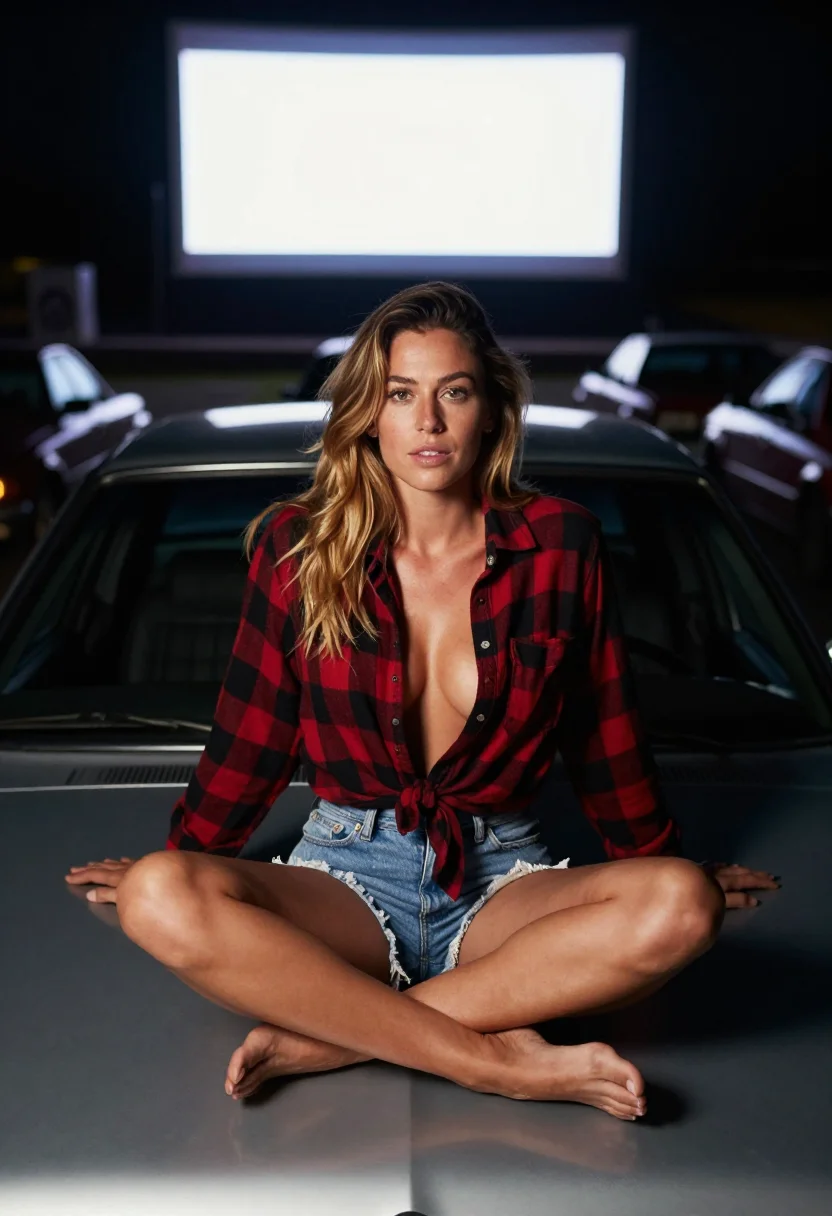
The Drive-In Look: The Last Row's Quiet Evening
The drive-in is the one theater where every car is its own small room — the last row especially, speaker hooked on the glass, the screen's silver weather washing across a windshield nobody else can see through.
The screen's own light does the work: silvering, flickering, described as abstract glow rather than any specific film. Other cars stay dark shapes, rows facing forward, never individuated.
The drive-in search ends here, honestly: nothing in these nine frames was pulled from a real theater. Each is written first — the hood, the bench seat, the blanket — then composed from the first pixel forward.
Frequently asked questions
- What is in the AI Drive-In Photoshoot pack?
- Nine frames at the drive-in's last row: three cross-legged on the hood in flannel and cutoffs, popcorn in her lap under the screen's silver glow; three on the bench seat with the flannel worn loose, feet on the dash, the speaker's tinny dialogue playing on; three on the hood with a blanket over her knees, chin on her hand, the last row's darkness hers alone.
- Are these real photographs or AI-generated?
- AI-generated, built on photographic principles. Light, fabric and material behave the way a real shoot would show them — it reads as a photograph, not as an illustration.
- Is this a real photo altered, or something else? What about age and compliance?
- Nothing is altered from an existing image. Each frame is written first, then composed from the first pixel forward; the model is not a real person. Access requires confirming you are 18 or over.
- What does the look change across the nine frames?
- It moves in three clear steps — on the hood in flannel and cutoffs, then inside on the bench seat with the flannel worn loose, then on the hood under a blanket over her knees. Every garment stays on through all nine frames. Nothing is caught mid-change; each step is its own composed frame.
- What's the wardrobe and setting?
- Flannel and cutoffs at a drive-in's back row — rows of dark, anonymous cars facing the screen, the speaker hooked on the glass, the interior lamp dimmed.
- Do I need to upload a selfie?
- It's optional. One clear front-facing photo casts the model in your likeness across all nine frames; skip it and the house casts its own. A less-than-perfect photo is fine — the free preview shows you the result before you pay.
- How does this compare with other AI photo tools?
- Other tools are a chat you steer or a prompt box refined one frame at a time. This is a pre-engineered nine-frame series — one last-row drive-in seat, the screen's silver glow — delivered whole for one payment.
- Can I use the frames once unlocked?
- Personal and creative use. Not for commercial redistribution, not to present as a real person's photograph, and not for use against any individual.
- Who is in the photos?
- A muse you choose. 32 AI faces, none of them a real person.
Who Reaches for the Drive-In Look
- People whose search was a drive-in photoshoot and want the last-row Americana look specifically
- Photographers studying how a projector screen's flicker reads as silver light across skin and denim
- Writers and worldbuilders who need one consistent character across a single drive-in night
- Anyone building a retro-Americana moodboard that has to hold one grade across nine images
- Nostalgia collectors drawn to the mid-century drive-in aesthetic
- Adults curious about the drive-in look of AI photography at an accessible entry price
About Ovid
Ovid is a house of pictures that were never taken. Most AI image tools ship one giant catalog of poses and aesthetics; the output looks like every other generated image on the internet. Ovid goes the other way. Each pack is a single editorial brief — light, styling, scene composed in the grammar of the great fashion editorials — hand-curated against real references and tested before it ships. Free preview before you pay. Packs are one-time. No template generator, no feed. A fashion house, not a catalog.