/combat-unit
AI Combat Android Portraits

Make it with your museAI Combat Android Portraits
Open this world on the wall, and make it with your muse.
all 9 frames of her, in this world ↓
The Combat Register: After the Field, Armour Stacked
The pack starts where the fighting has already stopped. Scrub, drifting smoke, dust on everything, a transport with its ramp down and its floods on — and a military gynoid walking out of it with her plating cracked at the hip. The register is combat-zone photojournalism rather than science-fiction poster art: available light only, weight on the good hip, nothing posed for the lens, and no badge or flag anywhere to attach the images to a real force.
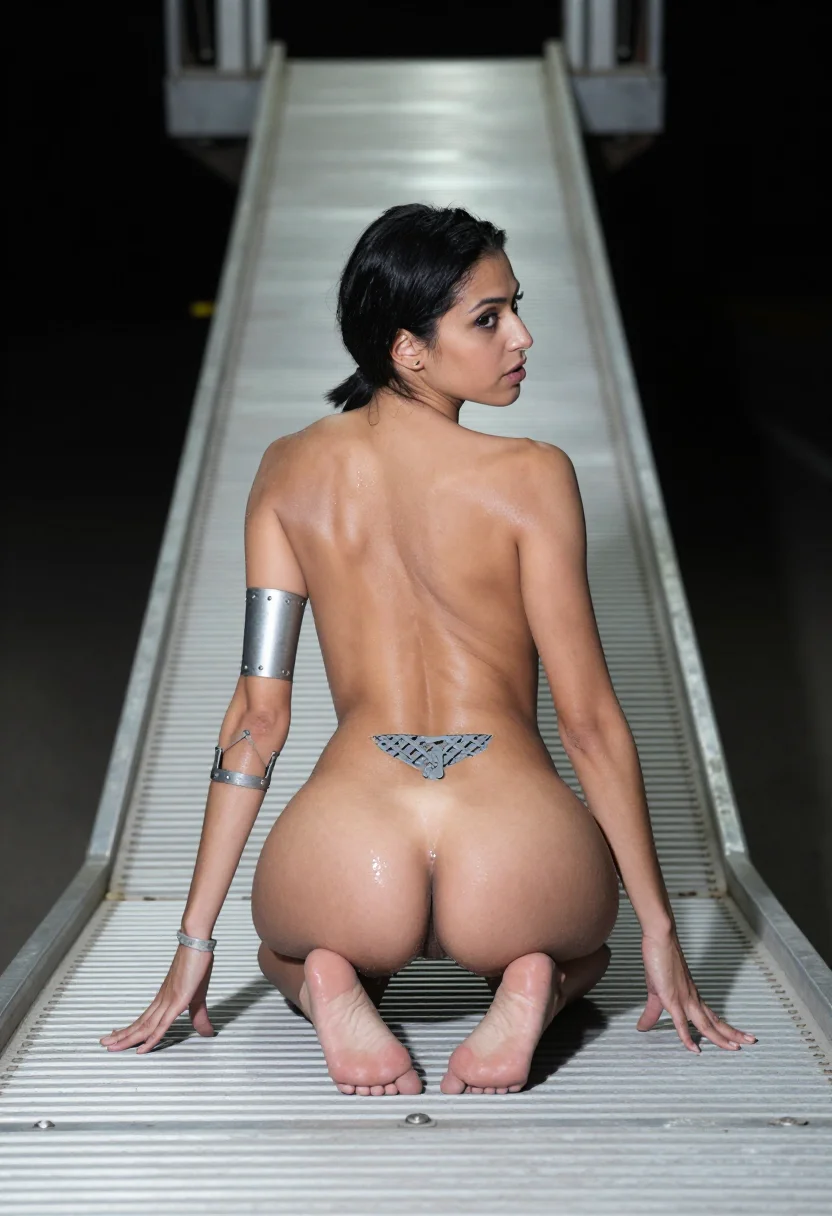
Three stages run the set, and the covering stays on with them. In the field: a tactical suit, the armour plate set down one shoulder and hanging by its strap, the crack at the hip showing the frame lattice through the split, one forearm plain metal to the elbow, the metal hand resting on the cracked plate. On the transport ramp: the armour set down and stacked, the suit peeled to the waist and hanging, one boot on the ramp's lip, the crack sparking faintly under the plating's edge. Under the floods: plain, lying back at three-quarters and framed from the head end, the plating stacked at the ramp's edge and the damage left exactly as the field left it.
The mechanical vocabulary is rationed to three nouns — metal forearm, cracked hip plate, frame lattice — one per limb, and the skin between them renders as skin. She is a woman who has been somewhere, not a schematic. That restraint is what makes the crack read as an injury rather than as a cutaway.
Three lights carry the sequence and they cool as it runs. Hard low sun from behind in the field, rim-lighting smoke and dust while the front planes fall to fill. Then two temperatures at once on the ramp: amber from the transport's interior behind her, violet dusk over the field in front. Then the floods — hard, white, near-vertical from the transport's spine, dust settling through the beam and the field black past the ramp's foot. All nine frames are photographic in construction and AI-generated in execution: shadow edge, specular on dusty metal, skin and fabric rendered from photographic principles, not drawn and not animated. No real person was photographed to make any of them.
Frequently asked questions
- What is in the AI Combat Android Portraits pack?
- Nine frames across the end of one deployment. Three in the field in a tactical suit with the armour plate set down one shoulder and hanging by its strap, the plating cracked at the hip to show the frame lattice through the split, one forearm plain metal to the elbow, dust on everything. Three on the transport ramp with the armour stacked and the suit peeled to the waist, seated with one boot on the ramp's lip. Three plain on the ramp under the transport's floods, the damaged hip still open to the frame. Three frames per stage, one payment for the set.
- Are these real photographs or AI-generated?
- AI-generated, built on photographic principles. The field third runs on a hard low sun from behind, rim-lighting dust and smoke and leaving the front planes in fill. The ramp third sits between an amber interior glow and a violet dusk sky, two colour temperatures meeting on the same body. The last third is white flood light from the transport's spine, hard and near-vertical, with the field black beyond the ramp's foot. It reads as combat-zone photojournalism, not as an illustration.
- Why is the damage not repaired?
- Because the pack is about the hour after, not the repair. The hip plating cracked in the field and stays cracked through all nine frames — sparking faintly under the plating's edge on the ramp, still open to the frame lattice under the floods. Leaving it is what makes the last third read as a body that has been somewhere rather than a body being displayed. A damaged android is the whole subject here, not an accident of one frame.
- How much of her is mechanical?
- Rationed to three things, one per limb: a metal forearm plain to the elbow, the cracked hip plate, and the frame lattice showing through the split. Nothing else is diagrammed. She is an adult woman built for the field, not a machine drawing — the skin reads as skin and the metal shows only where the field opened it.
- What is she wearing, stage by stage?
- First a tactical suit with the armour plate set down one shoulder and hanging by its strap, the metal hand resting on the cracked plate. Then the armour set down entirely and stacked on the transport ramp, the suit peeled to the waist and hanging. Then nothing, lying back at three-quarters on the ramp with the plating stacked at its edge. Each stage is a settled state, never a half-motion.
- Are there any insignia, flags or unit markings?
- None, deliberately. No badge, no flag, no unit number anywhere in the nine frames — the armour is plating and the transport is a transport. It keeps the set on the science-fiction register rather than attaching it to any real force, and it is why the only readable objects in frame are the crack, the dust and the stacked plate.
- How is this different from the Repair Shop pack?
- Repair Shop is the bench where damage gets worked on — a soldering iron, neon through a shutter, a back panel opened deliberately by a technician. This is the hour before any of that: the damage is raw, the dust has not been washed from, and nobody is fixing anything yet. Same open-frame vocabulary, different reason for it being open.
- How is this different from the Showroom Model pack?
- Showroom Model is the gynoid who has only ever been looked at — a boutique plinth, three spotlights, a satin sheath on a rail hook. This one has been used. The register there is display; here it is aftermath, and the light comes from a sun, a transport interior and a bank of floods rather than from three shop spots.
- How is the recline framed?
- From the head end, at three-quarters, with the metal forearm along the steel of the ramp — the composition looks down her length rather than up at her, and no limb is pointed at the lens. It keeps the last third in the same documentary register as the first two instead of switching to a pin-up one.
- How is this different from other AI photo tools?
- This is a pre-engineered nine-frame series — one deployment's end, three locations, three lighting logics — delivered whole for one payment. Better for a coherent set, worse if you want to negotiate every image.
- Can I use the frames once unlocked?
- Personal and creative use. Not for commercial redistribution, not to present as a real person's photograph, and not for use against any individual.
- Is this a fashion set? Is there an age requirement?
- The pack contains adult portrait, and access requires confirming you are 18 or over. The muse is an adult woman composed from a written brief rather than photographed, so she is not a real person; if you cast your own face into the set, that likeness is yours and yours only.
- Who is in the photos?
- A muse you choose. 32 AI faces, none of them a real person.
Who Reaches for the Combat Register
- People whose search was a combat android portrait and who want the aftermath register rather than a poster-art robot soldier
- Photographers studying how hard low backlight, a two-temperature dusk and a white flood bank each render dusty skin and metal
- Writers and worldbuilders who need one damaged synthetic soldier across a coherent nine-frame sequence
- Concept designers looking at armour plate that reads as plating over a frame rather than as a costume
- Anyone building a military gynoid moodboard that has to hold one grade across three locations
- Science-fiction illustrators after documentary framing and available light instead of studio glamour
- Collage artists who need photographic-quality battle-damaged synthetic material
- Adults curious about the battle-android register of AI portrait photography
About Ovid
Ovid is a house of pictures that were never taken. Most AI image tools ship one giant catalog of poses and aesthetics; the output looks like every other generated image on the internet. Ovid goes the other way. Each pack is a single editorial brief — light, styling, scene composed in the grammar of the great fashion editorials — hand-curated against real references and tested before it ships. Free preview before you pay. Packs are one-time. No template generator, no feed. A fashion house, not a catalog.