/cleaning-day
AI Cleaning Day Portrait
Make it with your museAI Cleaning Day Portrait
Open this world on the wall, and make it with your muse.
all 9 frames of her, in this world ↓
The Housework Register: Yellow Gloves, a Flat to Herself, a Working Afternoon
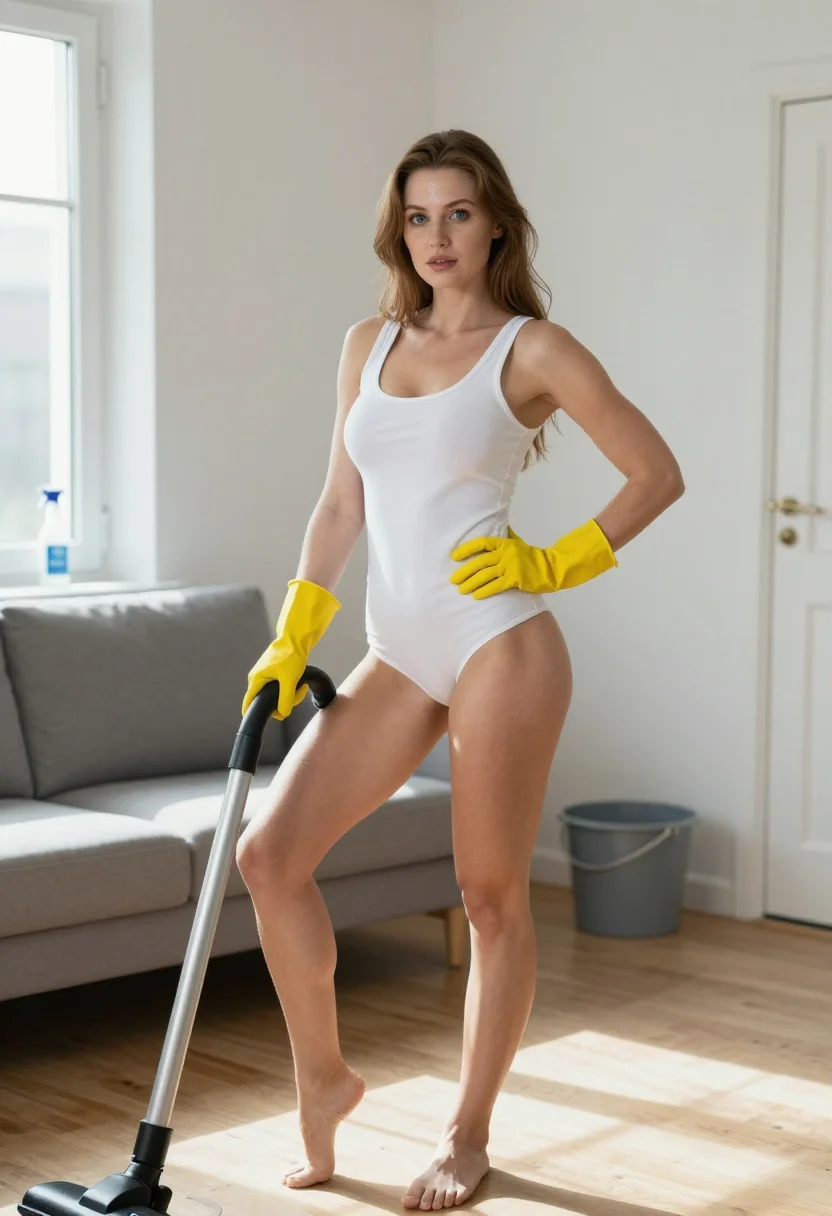
The premise is ordinary to the point of flatness, which is exactly why it holds: she is here to clean, the flat is empty, and the afternoon is hers. The tank top stays on and the gloves stay on. Nothing is performed for anyone — the vacuum's cord is looped, the sofa cushions are on the floor, a bucket sits by the door, and the work is genuinely half done through the last frame.
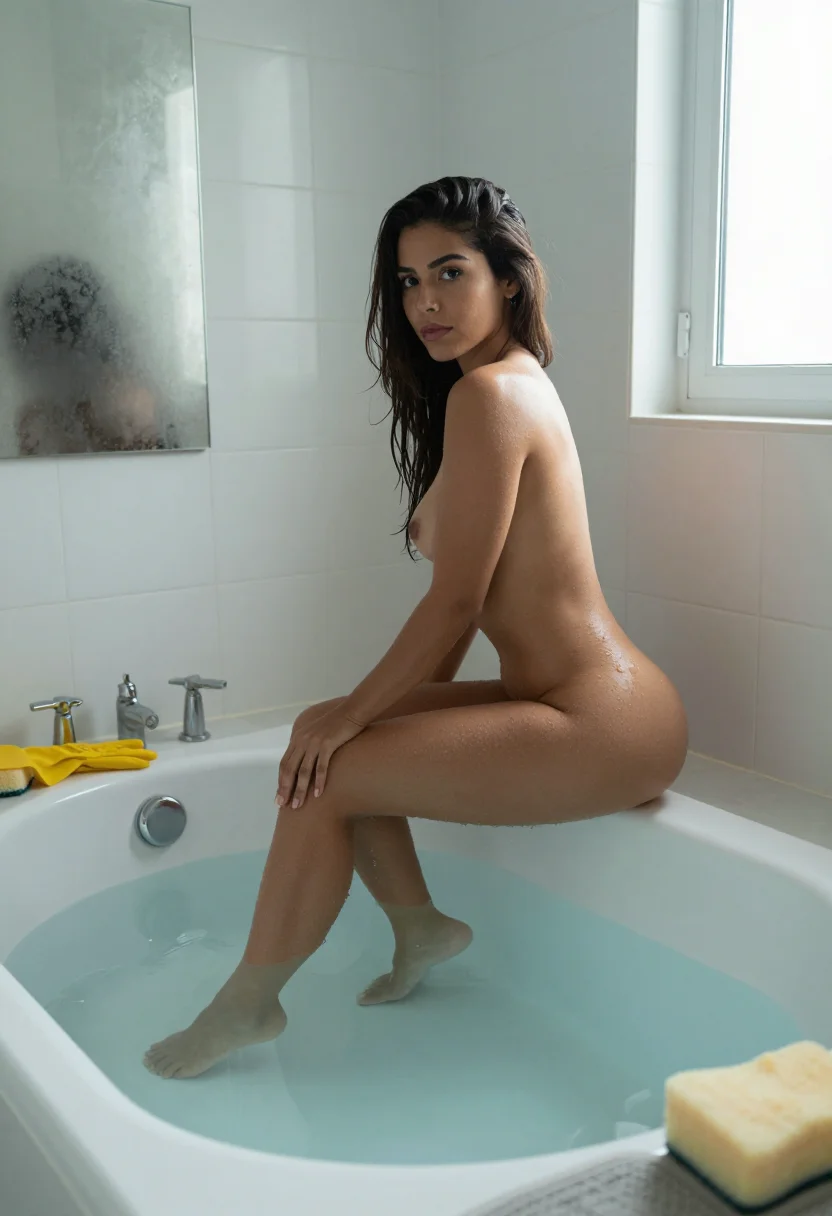
One source lights all nine frames: daylight, at its least flattering hour and used deliberately anyway. In the living room it comes flat through the window across floorboards and plain cotton, giving the yellow gloves their small hard speculars and leaving the room honest and unglamorous. In the bathroom it is tighter and bounced — white tile returns it as a wide soft sheen, the mirror fogs, the taps run. At the sink it breaks: a bright line on the water, a moving pattern from the window on the surface, enamel glowing behind her.
Rubber is the pack's material idea. Against skin it is the one surface that reads as instantly artificial — hard, glossy, saturated yellow, keeping its shape where a hand does not — and the register lives on that contrast. Everything else is chosen to stay matte and quiet around it: cotton, floorboards, grout, a sponge, an unlabelled spray bottle, a bathmat.
All nine frames are photographic in construction and AI-generated in execution. Specular highlight, shadow edge, fabric behaviour, water and skin are rendered from photographic principles rather than drawn or animated.
Frequently asked questions
- What is in the AI Cleaning Day Portrait pack?
- Nine frames from one afternoon alone in a flat: the living room in a tank top and yellow rubber gloves with the vacuum's handle in one gloved hand; the bathtub's edge, kneeling on the bathmat with both gloved forearms on the rim and a sponge under one hand; and by the taps with the water running, the gloves still on and the sleeves pushed up.
- Why do the gloves stay on?
- Because they are the whole signature of the register, and because they are the best object in the set. Yellow rubber is the one surface here with a hard, wet-looking shine: it catches the window in a small bright specular on every knuckle, and it keeps the work legible from the first frame to the last.
- Are these real photographs or AI-generated?
- AI-generated, built on photographic principles. Daylight carries the whole set with no help: flat and broad across floorboards in the living room, tighter and reflected from white tile in the bathroom, then broken on running water at the taps. Rubber, cotton, enamel, tile grout and wet skin all answer that one source differently. It reads as a photograph taken in a real flat at midday.
- What are the three situations?
- The living room — a tank top and yellow rubber gloves, the vacuum's handle in one gloved hand and the other on her hip, an unlabelled spray bottle on the window sill, sofa cushions on the floor and a bucket by the door. The bathtub's edge — kneeling on the bathmat with both gloved forearms on the rim, a sponge under one hand, the taps running and the mirror fogged, her hair tied up. The taps — by the sink with the water running, the sleeves pushed up, the gloves still on.
- Why is the water running at all?
- She is testing the taps, which is a real reason and the only one the pack needs. It also earns the set's best light: everything before it has been flat daylight on matte floorboards and white tile, and running water breaks that light into something moving and legible — a bright line at the waterline, a soft glow on the enamel, the window's shape shifting on the water.
- How is this different from the Laundry Day pack?
- Laundry Day is a woman waiting for a machine in a cupboard-sized utility room, in a shirt she did not choose. This one is a whole flat and a whole afternoon, with equipment: a vacuum, a spray bottle, a bucket, gloves. There the premise is waiting; here the premise is work.
- What does she wear across the set?
- A plain cotton tank top and yellow rubber gloves, worn through the whole afternoon, with the sleeves pushed up at the sink. Hair tied up from the second situation onward. No jewellery, no styling — the props are the wardrobe here: a vacuum, an unlabelled spray bottle, a sponge, a bucket, a bathmat.
- Do I need to upload a selfie?
- It is optional. One clear front-facing photo casts the muse in your likeness across all nine frames; skip it and the house casts its own. Your selfie steers the face — it is never the image being altered.
- What makes this set different from a single image?
- One flat, one afternoon, three working situations — nine frames delivered whole for one payment, built to read as one scene.
- Can I use the frames once unlocked?
- Personal and creative use. Not for commercial redistribution, not to present as a real person's photograph, and not for use against any individual.
- Is there an age requirement?
- Access requires confirming you are 18 or over. The muse is an adult woman composed from a written brief rather than photographed, so she is not a real person; if you cast your own face into the set, that likeness is yours and yours only.
- Who is in the photos?
- A muse you choose. 32 AI faces, none of them a real person.
Who Reaches for the Housework Register
- People searching for a cleaning day portrait who want a real flat at midday rather than a costume shoot
- Anyone building a rubber gloves moodboard that has to hold one daylight source across nine images
- Photographers studying how flat daylight behaves across glossy rubber, matte cotton, white tile and moving water
- Writers and worldbuilders who need one consistent adult character across a single working afternoon
- Collage and edit artists who need photographic-quality bathroom material rather than glamour lighting
- Readers of domestic fiction who want the working day stated plainly instead of implied
- Adults curious about the housework register of AI photography at an accessible entry price
About Ovid
Ovid is a house of pictures that were never taken. Most AI image tools ship one giant catalog of poses and aesthetics; the output looks like every other generated image on the internet. Ovid goes the other way. Each pack is a single editorial brief — light, styling, scene composed in the grammar of the great fashion editorials — hand-curated against real references and tested before it ships. Free preview before you pay. Packs are one-time. No template generator, no feed. A fashion house, not a catalog.